Teasel Root Tincture vs Capsules for People Who Dislike Bitter Herbal Taste
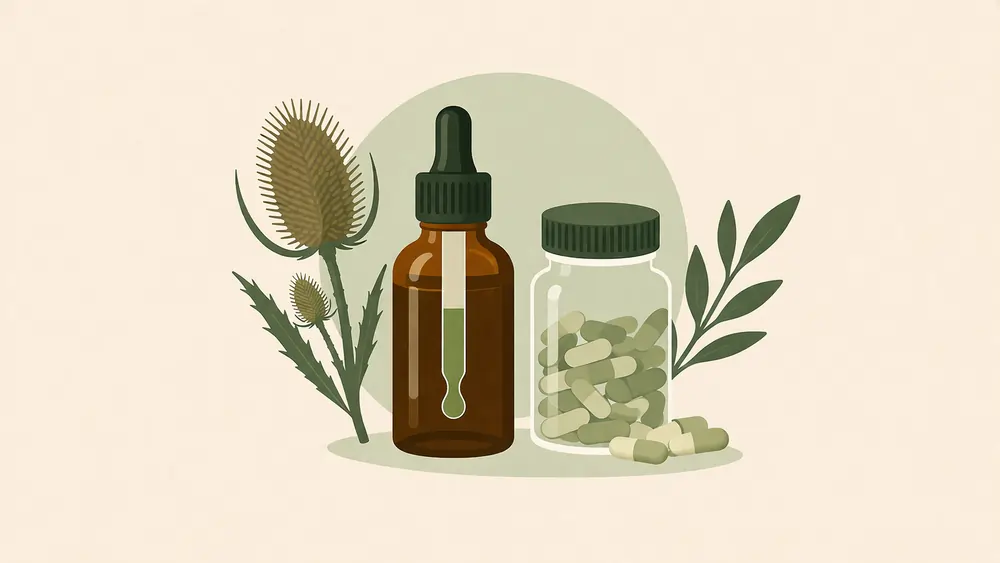
Teasel Root Tincture vs Capsules is not a small detail if you already know you dislike bitter herbal taste. For many people, the real problem is not interest in the herb. It is the format. A tincture may feel flexible and fast, but the taste can be direct and hard to ignore. Capsules usually remove most of that issue, but they change the daily experience in other ways. This guide explains the difference in plain English, with a focus on bitterness, convenience, portability, routine fit, and what usually works best for taste-sensitive users.
What is the real difference between teasel root tincture and capsules?
The main difference is format. A tincture is a liquid herbal extract, usually taken by dropper in a small amount of water or another drink according to the label directions. Capsules contain teasel root powder or dry extract in a swallowable shell.
That sounds simple, but the user experience is very different. A tincture meets your senses right away. You notice the smell, the flavor, and the aftertaste. Capsules create distance. You swallow them with water, so direct taste exposure is much lower.
For people who dislike bitter, earthy, or sharp herbal notes, that difference often matters more than branding or product style.
Which option is usually better for people who dislike bitter herbal taste?
For most people, capsules are the easier choice when taste is the main issue.
A tincture can still work, especially if you dilute it well, but it usually keeps some noticeable herbal intensity. Capsules usually avoid that problem because the herb is enclosed and swallowed quickly.
If your question is practical and honest — “I want teasel root, but I do not want to deal with a bitter herbal taste every day” — capsules are often the more comfortable starting point.
How does taste differ in real life?
Tincture taste experience
A tincture usually has a concentrated herbal flavor. Even when mixed into water, the taste can still feel sharp, earthy, or bitter. Some people do not mind this because the serving is quick. Others find the aftertaste strong enough to make daily use unpleasant.
Capsule taste experience
Capsules usually have little to no taste during normal use. You may notice a mild herbal smell from the bottle, but you usually do not experience the herb directly on the tongue.
Why this changes routine success
If taste makes you hesitate every day, your routine becomes less stable. That is why bitterness is not a minor detail. It affects whether a product feels easy enough to keep using.
Quick comparison table: teasel root tincture vs capsules
| Factor | Teasel Root Tincture | Teasel Root Capsules |
|---|---|---|
| Taste exposure | High | Low |
| Best fit for bitter-taste sensitive users | Lower | Higher |
| Routine speed | High | High |
| Dose flexibility | Usually easier to adjust in small increments | Usually more fixed |
| Portability | Moderate | High |
| Mess risk | Higher | Low |
| Ease for beginners | Moderate | High |
Why do capsules usually work better for taste-sensitive users?
Capsules solve the most obvious problem first. They reduce direct contact with the herb’s flavor.
That matters because many people are not looking for a “better” herb in theory. They are looking for a format they can tolerate without daily resistance. Capsules are often better at that because they simplify the experience. There is no dropper taste, no lingering bitterness, and no need to disguise the flavor in a drink.
For people who already know they struggle with strong herbal products, that can make capsules the more realistic format.
When does a tincture still make sense?
A tincture can still make sense if your main priority is flexibility rather than taste.
Liquid extracts are often easier to measure in smaller or more gradual increments. Some people also prefer drops because they dislike swallowing pills. Others simply like liquid herbal products and do not see taste as a problem.
A tincture may also fit people who are willing to mix it into more water or another drink to reduce intensity. That does not remove the bitterness completely, but it can make the format workable.
So tincture is not the wrong choice. It is just often the harder choice for people whose main issue is taste aversion.
When do capsules make more sense?
Capsules usually make more sense in these situations:
- you dislike bitter or earthy herbal flavors;
- you want a fast, low-friction daily routine;
- you travel often or need something easy to carry;
- you prefer a pre-measured format;
- you do not want to think about masking taste every day.
For beginners, this often makes capsules the more practical first step.
Is one format more beginner-friendly?
Yes. For most beginners, capsules are easier.
They require less decision-making. You do not need to think about flavor, dilution, or how to take the product in a drink. You simply follow the label directions and swallow the capsule with water.
Tinctures are not difficult, but they ask for a little more comfort with herbal intensity. If someone is already unsure about taste, capsules usually lower the barrier to entry.
Does dose flexibility change the decision?
It can. This is one of the few areas where tinctures often have a practical advantage.
A tincture is commonly measured by drops or droppers, which can make fine adjustments easier within the product directions. Capsules are more fixed. You usually take a specific number of capsules, so the format feels less flexible.
That does not make tinctures better overall. It just means the better option depends on your priority. If your priority is flavor avoidance, capsules usually win. If your priority is more adjustable liquid serving control, tincture may appeal more.
How do they compare for daily convenience?
Both formats can be convenient, but in different ways.
At home
Both work well at home. Capsules are faster to take. Tinctures are also quick, but they often need mixing or at least a moment of measuring.
At work
Capsules are usually more discreet and simpler. A tincture bottle can feel less convenient if you need to measure drops in a shared space.
While traveling
Capsules usually win because they are compact, clean, and easy to pack. Tinctures are portable too, but liquid bottles are often less convenient in bags and daily carry.
Decision table: which format fits which person?
| User type | Better fit | Main reason |
|---|---|---|
| Dislikes bitter herbal taste | Capsules | Less direct flavor exposure |
| Dislikes swallowing pills | Tincture | Liquid format may feel easier |
| Wants quick daily use | Capsules | Simple and low effort |
| Wants more serving flexibility | Tincture | Often easier to measure in smaller increments |
| Travels often | Capsules | More portable and less messy |
| Already likes liquid herbal extracts | Tincture | Matches personal preference |
What if you want tincture convenience but dislike the taste?
This is a common middle-ground problem. Some people like the idea of a tincture because it feels flexible and quick, but the flavor keeps getting in the way.
In that situation, people often try more water, a small amount of juice, or another allowed mixer according to the label. That can reduce bitterness, but it usually does not erase it completely. The herbal note still tends to come through.
If you already know that strong flavors make you avoid products, capsules are often the more dependable answer. They remove the need for daily taste management.
Are there any label-reading points beginners should not ignore?
Yes. Teasel root products are dietary supplements, so the label matters.
Check the serving size, ingredient list, and plant part information. Some tinctures or capsules may contain additional herbs, fillers, capsule materials, or other inactive ingredients. Make sure you understand whether the product is a single-herb format or a blend.
If you take medications, are pregnant, breastfeeding, or have a medical condition, it is sensible to speak with a qualified healthcare professional before starting a new supplement. Human evidence around many traditional herbs remains limited, so a cautious approach is appropriate.
Checklist: how to choose between teasel root tincture and capsules
- Choose capsules if bitter taste is your main concern.
- Choose tincture if you prefer liquid supplements.
- Choose capsules if you want the simplest daily routine.
- Choose tincture if swallowing pills is difficult for you.
- Check whether the formula contains only teasel root or a blend.
- Review serving size and ingredient list before buying.
- Think about where you will use it most: home, work, or travel.
- Pick the format you are most likely to use consistently.
What is the simplest answer for bitter-taste sensitive users?
If you dislike bitter herbal taste and want the most practical format, capsules are usually the better first choice. They reduce direct flavor exposure, simplify routine use, and often fit more easily into daily life.
Tinctures still make sense for people who prefer liquid extracts or want more serving flexibility. But for taste-sensitive users, capsules usually have the clearer advantage.
FAQ about Teasel Root Tincture vs Capsules
Which is better if I dislike bitter herbal taste?
Capsules are usually better because they reduce direct taste exposure.
Does teasel root tincture always taste strong?
Not always in the same way, but tinctures usually have a more noticeable herbal flavor than capsules.
Are capsules easier for beginners?
Usually yes. They are simple, low-mess, and easier to fit into a routine.
Who may still prefer a tincture?
Someone who dislikes swallowing pills or prefers liquid herbal products may still prefer a tincture.
Can I reduce tincture bitterness by mixing it into a drink?
Often yes, but the herbal taste usually remains noticeable to some degree.
Are capsules completely tasteless?
They are usually close to tasteless during normal use, though the bottle may have a mild herbal smell.
Does label quality matter for both forms?
Yes. Serving size, ingredient list, and added ingredients matter in both tinctures and capsules.
Glossary
Tincture
A liquid herbal extract taken in small measured servings.
Capsule
A supplement form that contains powder or dry extract inside a swallowable shell.
Serving size
The amount of product suggested for one use on the label.
Extract
A concentrated preparation made from plant material.
Ingredient panel
The section of the label that lists active and inactive ingredients.
Taste exposure
How much of the herbal flavor you directly notice during use.
Portability
How easy a product is to carry and use away from home.
Consistency
How reliably a person can keep using a product over time.
Conclusion
In the teasel root tincture vs capsules comparison, capsules are usually the easier option for people who dislike bitter herbal taste. Tinctures offer flexibility, but capsules usually win on comfort, simplicity, and daily routine fit.
Used Sources
General educational context explaining tinctures as liquid extracts and capsules as low-taste supplement formats, herbal supplement format references — mountainroseherbs.com and similar herbal education resources
Consumer supplement guidance on capsules, tinctures, serving style, and ingredient-label reading, dietary supplement education materials — nih.gov and general supplement education resources
General herbal reference context for teasel root sold in tincture and capsule-style supplement formats, herbal product reference materials — botanical materia medica and herbal merchant education sources
Dietary supplement safety context supporting cautious, non-claim-based language and label-first decision-making, supplement safety references — ncbi.nlm.nih.gov/books and nih.gov